This is in regards to chemicals used on the farms of neighboring lots and determining what harmful effects they have on humans and/or honeybees. Neighboring a coconut and mango orchard are chemically treated rice fields. The goal is to familiarize with the details of each that farmers stated using.
Frequency of use is claimed by the farmers to be every three months for one day.
Pesticide - Padan
The following excerpts summarized from The New Japanese Pesticide Cartap (Padan): Is It As Environment Friendly As Claimed? Click here to read that on Google Books.
Developed in Japan to combat rice stem borer, chewing and sucking insects; claims, to have almost no effect on natural predators of pests, no effect on fish (after three days after application and practically nontoxic to mammals. Their subject for testing was tilapia.
It was observed that in all cases, percentage mortality increased with the concentration of the pesticide and the duration of exposure; the mortality of fish occurred steadily with the passage of time in each of the CHC concentrations [...] thus indicating that the pesticide had not either substantially degraded with time or the degradation products themselves were toxic. These observations question the claims of the manufacturers of CHC that the pesticide is easily decomposed in water if it does not get absorbed by the soil or plants, thus having very low toxicity to fish.
A supplier in Santa Cruz, California provides the below graphic in regards to human safety and even states that Cartap is "toxic to bees." Just below that states, "very toxic to aquatic organisms, may cause long-term adverse effects in the aquatic environment. Farmers are recommended to have various safety equipment, which, also includes a respiratory, overall and eye protection.
The unique property of honey lies in its ability to fight infection on multiple levels, making it more difficult for bacteria to develop resistance, said study leader Susan M. Meschwitz, Ph.D. [...] The osmotic effect, which is the result of the high sugar concentration in honey, draws water from the bacterial cells, dehydrating and killing them."
...another advantage of honey is that unlike conventional antibiotics, it doesn’t target the essential growth processes of bacteria. The problem with this type of targeting, which is the basis of conventional antibiotics, is that it results in the bacteria building up resistance to the drugs.
We have run standard antioxidant tests on honey to measure the level of antioxidant activity,” she explained. We have separated and identified the various antioxidant polyphenol compounds. In our antibacterial studies, we have been testing honey’s activity against E. coli, Staphylococcus aureus and Pseudomonas aeruginosa, among others.”
A question we should all ask ourselves before deciding the make the purchase. Health store or not, there are definitely adulterated honeys being sold on the market. Reports show that honey is one of the top adulterated foods. Beekeepers all over the world are required to battle honey that's watered down, mixed with other ingredients and Tests Show Most Store Honey Isn’t Honey:
Ultra filtering is a high-tech procedure where honey is heated, sometimes watered down and then forced at high pressure through extremely small filters to remove pollen, which is the only foolproof sign identifying the source of the honey. It is a spin-off of a technique refined by the Chinese, who have illegally dumped tons of their honey – some containing illegal antibiotics – on the U.S. market for years.
How To Identify Adulterated Honey?
The dissolving test.
Claims say that if it dissolves, then its mixed with sugar, water, fructose syrup or all of these.
By flame
If it burns, its real - the idea being that the adulterated honey is too high in water.
Fluidity
Similar to the dissolving test - if a drop of honey on your finger keeps its structure, its pure. This one can probably be debated as honeys vary in texture depending on the floral. For example, sunflower honey tends to be more golden and fluid where Macadamia Nut honey is dark and thick.
Here's a video showing those tests in action. *Note* In the end, the video states that the honey is purchased from Bohol Bee Farm, which is actually NOT a bee farm. They claim that their hives were destroyed in a previous typhoon (but only had two anyway). Bohol Bee Farm is simply a resort that sells the byproducts.
Check for bubble
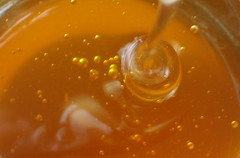
If there are bubbles existing within the jarred bottle, this is an indication that the honey has not been heated to keep it from crystallizing. After a certain temperature, advocates say that the beneficial enzymes are destroyed.
Arguments can be made here as well that bubbles do occur during some filtration methods and some adulterers even go out of their way to "install" bubbles in the bottled honey.
The University Of The Philippines Los Baños (UPLB) released a Quick Test
To Detect Adulterated Honey from their Institure of Chemistry with a
technique using a starch solution, iodine tincture and hot water bath.
Those willing to test their honey can download the PDF here.
NPR (National Public Radio) tried to shed some light on the sticky situation back in 2011:
Bottom line: Supermarket honey doesn't have pollen, but you can still call it honey. Call it filtered honey. And the lack of pollen says nothing about where it may have come from.
=======
UPDATE
There is some good feedback from the beekeeping community on the subject at a LinkedIn group. Click here to see that dialogue.